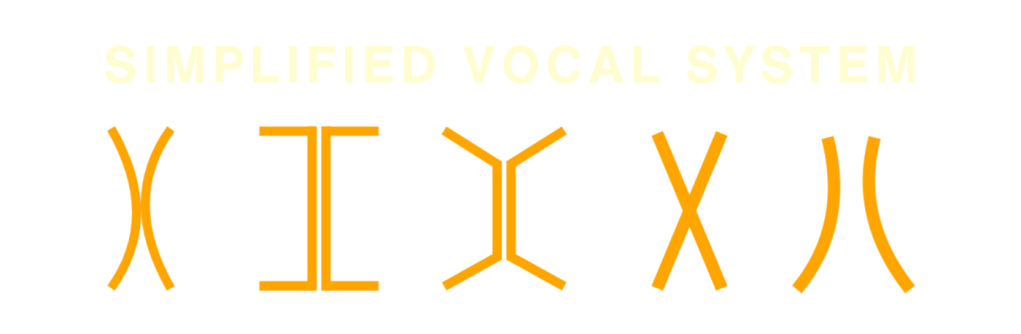
A SIMPLER WAY TO PRACTISE AND TEACH SINGING
The Simplified Vocal System
Learning and practising singing without boxes: no chest voice, no head voice, no mix, no registers, no mechanisms.
Why simplify
Singing pedagogy has fallen into the habit of sorting sounds into boxes, and then squeezing any sound into one of them — sometimes by force — in order to justify the existence of the boxes.
The Simplified Vocal System is a system without boxes. It keeps only the essential elements and describes them with words you can locate in your own body: the diaphragm, the vocal folds, the larynx, the mouth.
Nothing else.
It is aimed at singers of every level and at teachers, for their daily practice.
Three floors for understanding how sound is produced
The Simplified Vocal System describes a comfortable sound as the result of a smooth coordination between:
A
What happens below the larynx
Controlling the rise of the diaphragm: giving the air the right flow and the right pressure.
B
What happens at the level of the larynx
Controlling the vibration of the vocal folds, the twang, and the projection.
C
C
What happens above the larynx
Controlling the space of resonance, the vowels, the articulation.
What happens on one floor directly affects the others. The Simplified Vocal System aims at the synergy of these parameters, for a voice that is healthy, flexible, varied and rich.
Only five elements to control (almost) everything
- The rise of the diaphragm — support.
- The way the vocal folds vibrate — stronger, softer, more partial.
- The narrowing of the aryepiglottic funnel — the twang.
- The projection of the sound — more open, more contained, more held back.
- The space of resonance — larger, smaller.
Comfort is the only way.
An uncomfortable sound is always a badly executed sound. Repeating an uncomfortable exercise will never make it comfortable — it leads to vocal fatigue. Repeating a comfortable exercise, on the other hand, spreads like an oil stain and opens the way to new sounds.
What the Simplified Vocal System does not claim to be
The scientific study of the voice is recent and our tools are imperfect. The diagrams and explanations in the system are keys to understanding and broad tendencies, not settled truths.
Some of it will help you a great deal, some of it not at all. Keep only what helps you.
Practise it in a group
The group lessons are built entirely on the simplified vocal system.
Online, live.
The book
The complete work: the three floors, the different ways the vocal folds vibrate, the twang, the projection, the resonance, the essential rules, plus some forty practical sheets and reflections on singing.
 Tout chanter! École de la voix - FR